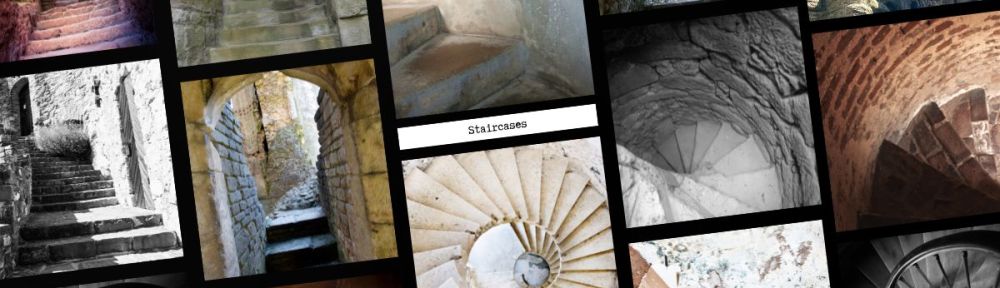
The direction of the staircases in Broadstone Castle is mentioned a few times in ‘Justified’, but is it true that staircases were deliberately built in a clockwise (from the bottom upwards) direction to hinder raiders?
The theory is that attackers from below would struggle to wield a sword upwards without clanging into the central newel column (the narrowest part of the staircase) and they’d have to reach around the curve blindly while attacking. Perhaps more importantly, defenders retreating upwards would have the advantage of greater space to swing their sword arm downwards and a better view of the invaders below.
You could argue that anti-clockwise is just as problematic. Attackers would have their right hand (usually the sword wielding arm) against the outer wall of the staircase, which isn’t ideal either.
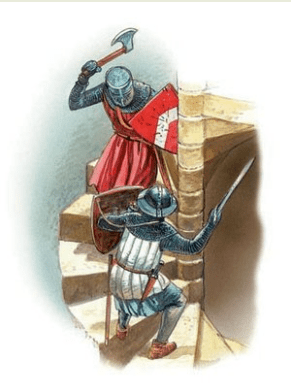
This image (from Newcastle Castle’s archives) demonstrates the issue. Undoubtedly, the attacker below is in an awkward position and is going to have a tough time swinging his sword around the central post to his right. But the chap with the axe isn’t having much fun either. His shield arm is scrunched up against the newel and he’s at risk of bashing his right arm against the outer wall as he swings.
Fighting in a tight, circular space is tough for both parties.
While there’s little solid evidence to support the case for clockwise construction, there’s also no evidence which proves otherwise. Sometimes, as John says in ‘Justified’, interpreting medieval history involves reading between sketchy lines and there’s no documented proof that potential attacks were ever an architectural or engineering consideration. You could argue, that if invaders are in your stairwell the battle is probably already lost.
A potentially more useful ploy was to build uneven stairs. The regular occupants would be aware of the irregularities, but an unseasoned invader would be more likely to stumble and alert the defenders above of their approach. Again though, were uneven steps a deliberate design feature or just a result of years of use and the availability of materials at the time?
There are also practical considerations. Someone carrying a pail in their right hand for example would find it easier to ascend in a clockwise direction. Or perhaps the stairwells were used in pairs, with one for ascending, one for descending, as passing on a spiral staircase is a tricky business. It makes sense that practical, daily considerations would outweigh the possibility of needing to fight invaders.
During my research for the book, the most comprehensive study I found on this subject was compiled by the Castle Studies Group. Established in 1987 by the then Secretary Dr Robert Higham, the Castle Studies Group includes members both professional and amateur from a wide and varied range of historical and archaeological backgrounds, both in the British Isles and overseas.
Their extensive study of this subject, including dozens of site visits, shows that while Norman castles did favour clockwise staircases, from the mid-1200s to the end of the 15th century, anti-clockwise took over. In some instances, this appeared to be a design preference or for domestic flow, with staircases in opposing towers mirroring each other rather than turning in the same direction.
So, gradually over several hundred years, the trend for clockwise evolved into a tendency to have both, and aesthetic needs overtook practical considerations.
A bit like mobile phones, which started out as handheld bricks, went smaller and smaller and are now huge again …
If you have a spiral staircase, let me know which way it goes!
If this intrigues you, more comprehensive articles on the subject can be found below:
The Rise of the Anti-clockwise Newel Stair, Neil Guy, http://www.castlestudiesgroup.org.uk/CSGJournal2011-12X5stairs.pdf
Mediaeval Mythbusting Blog #3: The Man Who Invented the Spiral Staircase Myth, James Wright, https://triskeleheritage.triskelepublishing.com/mediaeval-mythbusting-blog-2-the-man-who-invented-the-spiral-staircase-myth/
Thanks for taking the time to read this post. If you found it informative and entertaining, please consider sharing it with your friends and followers on social media. And if you have any feedback or suggestions for future topics, I’d love to hear from you in the comments below. Don’t forget to subscribe for more content and updates, or pop over to my newsletter page for more crime stuff, direct to your inbox every month.
See you soon.

Wendy
 Wendy Turner-Hargreaves